

 Deutsch
 English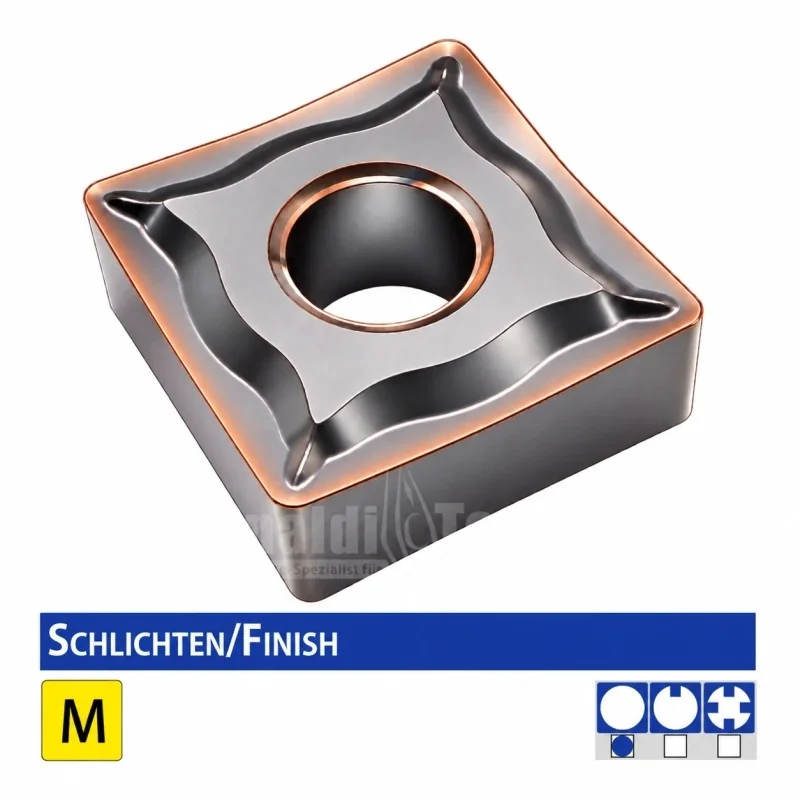
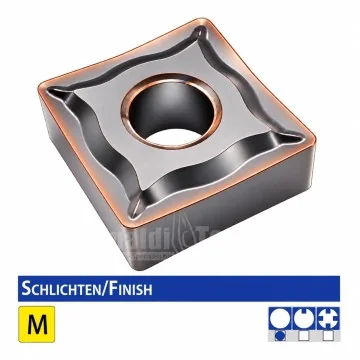
| Shape | SNMG |
| Processing | Finish |
| Cutting condition | Continuous |
| Workpiece Material | Stainless Steel |
| Grade | RT305: PVD grade M20-M30 for stainless steel with the most modern coating |
| Packaging unit | 10 Pc. |
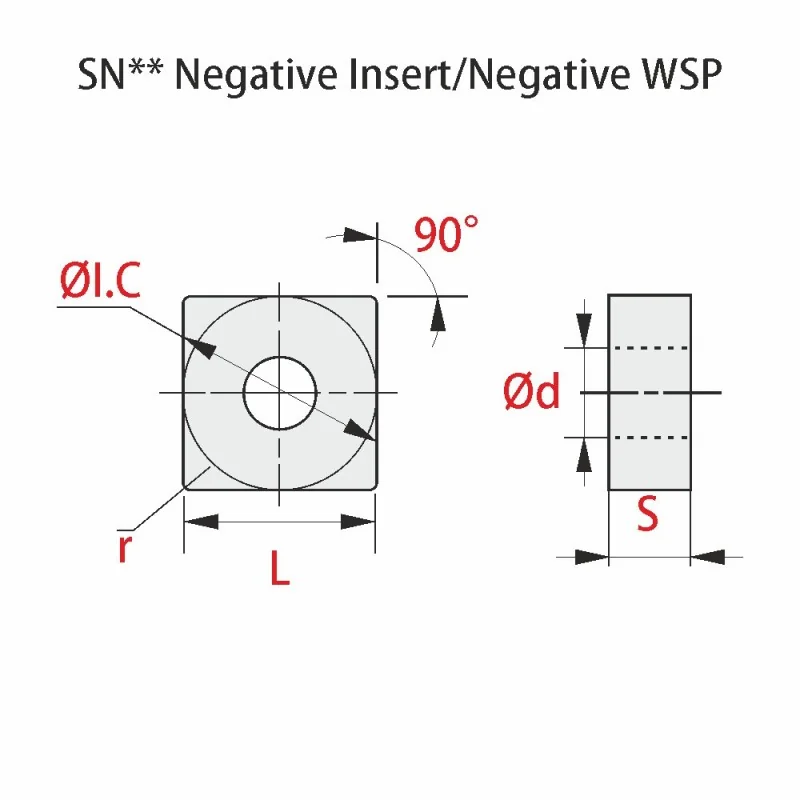
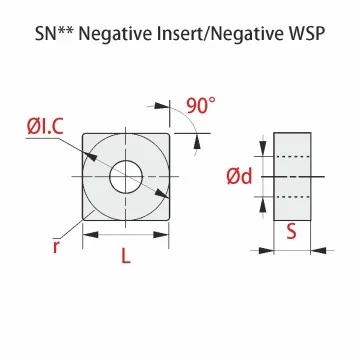
| r | L | I.C | S | d | |
| SNMG 120404-FE RT305 | 0,4 | 12,7 | 12,7 | 4,76 | 5,16 |
| SNMG 120408-FE RT305 | 0,8 | 12,7 | 12,7 | 4,76 | 5,16 |
| SNMG 120412-FE RT305 | 1,2 | 12,7 | 12,7 | 4,76 | 5,16 |
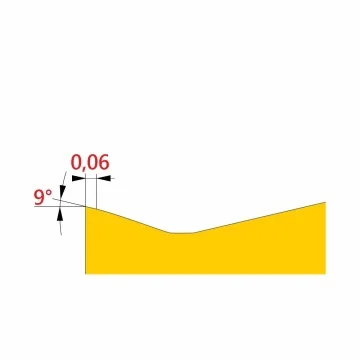
The indexable insert SNMG...-FE in the PVD-coated RT305 grade is consistently designed for professional stainless steel machining. With its specific FE geometry for continuous cutting, this turning insert promotes an excellent surface finish and supports efficient workflows in metal cutting operations. 
The indexable insert SNMG...-FE RT305 is a well-thought-out solution for finishing operations with continuous cutting. The combination of the proven SNMG basic shape and the specialized FE geometry opens up flexible application possibilities in modern turning. Through the advanced PVD coating of the RT305 grade (M20-M30), the machining of stainless steels is supported reliably, creating ideal conditions for consistent work results and long tool life in series production.

| Item Nr. | r | L | I.C | S | d | |
| SNMG 120404-FE RT305 | 1661461 | 0,4 | 12,7 | 12,7 | 4,76 | 5,16 |
| SNMG 120408-FE RT305 | 1661462 | 0,8 | 12,7 | 12,7 | 4,76 | 5,16 |
| SNMG 120412-FE RT305 | 1661463 | 1,2 | 12,7 | 12,7 | 4,76 | 5,16 |
| Stainless Steel | |||
| Vc (m/min) | fn (mm/U) | ap (mm) | |
| SNMG 120404-FE RT305 | 80-160 | 0,07-0,25 | 0,2 -1,5 |
| SNMG 120408-FE RT305 | 80-160 | 0,07-0,25 | 0,2 -1,5 |
| SNMG 120412-FE RT305 | 80-160 | 0,07-0,25 | 0,2 -1,5 |
This carbide insert is geared towards professional use in the finishing of stainless steel workpieces. The FE geometry proves itself particularly well in applications requiring outstanding surface quality, while the RT305 grade ensures reliable performance during continuous cutting. As a result, the cutting insert is ideally suited for precision manufacturing where exact tolerances and consistent dimensional accuracy are demanded.
A key characteristic of this insert is the alignment of the PVD-coated M20-M30 grade with the specific challenges of stainless steel machining. The combination of the FE cutting geometry with the stable SNMG design ensures excellent chip formation and promotes a light cutting action. This reduces the load on the machine and tool holder, which ultimately contributes to the economic efficiency of the machining process.
| Shape | SNMG |
| Processing | Finish |
| Cutting condition | Continuous |
| Workpiece Material | Stainless Steel |
| Grade | RT305: PVD grade M20-M30 for stainless steel with the most modern coating |
| Packaging unit | 10 Pc. |
| r | L | I.C | S | d | |
| SNMG 120404-FE RT305 | 0,4 | 12,7 | 12,7 | 4,76 | 5,16 |
| SNMG 120408-FE RT305 | 0,8 | 12,7 | 12,7 | 4,76 | 5,16 |
| SNMG 120412-FE RT305 | 1,2 | 12,7 | 12,7 | 4,76 | 5,16 |
The indexable insert SNMG...-FE in the PVD-coated RT305 grade is consistently designed for professional stainless steel machining. With its specific FE geometry for continuous cutting, this turning insert promotes an excellent surface finish and supports efficient workflows in metal cutting operations.
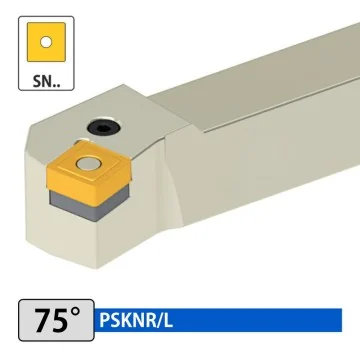
| External Tool Holder | PSKNR/L |
| Cutting Angle | 75° |
| Insert | SN.. |
| Main application | Facing |
| Clamping | Pin Lock |
| Packaging unit | 1 Pc. |
| h=H | B | L | f | |
| PSKNR/L 2020 K12 |
20 | 20 | 125 | 25 |
| PSKNR/L 2525 M12 |
25 | 25 | 150 | 32 |
| PSKNR/L 3232 P12 |
32 | 32 | 170 | 40 |
| PSKNR/L 2525 M15 |
25 | 25 | 150 | 32 |
| PSKNR/L 3232 P15 |
32 | 32 | 170 | 40 |
| PSKNR/L 3232 P19 |
32 | 32 | 170 | 40 |
| PSKNR/L 4040 S19 |
40 | 40 | 250 | 50 |
The PSKNR/L external tool holder with a 75° cutting angle is an ideal solution for precise face turning operations. Utilizing a reliable pin lock clamping system, it ensures secure fixation and quick indexing of SN inserts. Designed for high process stability in professional machining, this holder supports efficient workflows in both single-part and batch production.
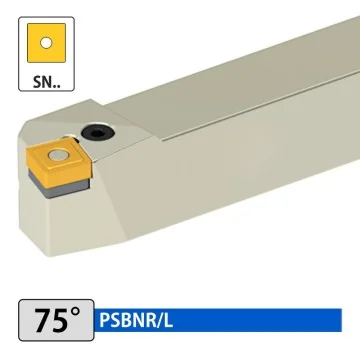
| External Tool Holder | PSBNR/L |
| Cutting Angle | 75° |
| Insert | SN.. |
| Main application | Longitudinal turning |
| Clamping | Pin Lock |
| Packaging unit | 1 Pc. |
| h=H | B | L | f | |
| PSBNR/L 2020 K12 | 20 | 20 | 125 | 17 |
| PSBNR/L 2525 M12 |
25 | 25 | 125 | 22 |
| PSBNR/L 3232 P12 |
32 | 32 | 170 | 27 |
| PSBNR/L 2525 M15 |
25 | 25 | 150 | 22 |
| PSBNR/L 3232 P15 |
32 | 32 | 170 | 27 |
| PSBNR/L 3232 P19 |
32 | 32 | 170 | 27 |
| PSBNR/L 4040 S19 |
40 | 40 | 250 | 35 |
The external tool holder PSBNR/L (75°) is designed for productive longitudinal turning using SN inserts. Featuring a reliable pin lock clamping system, it provides high stability for consistent machining processes in professional environments.
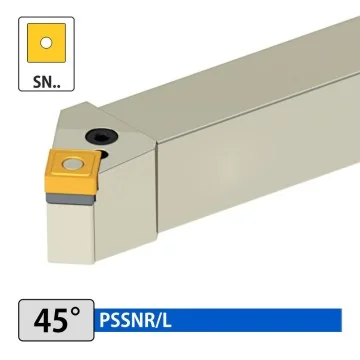
| External Tool Holder | PSSNR/L |
| Cutting Angle | 45° |
| Insert | SN.. |
| Main application | Longitudinal turning, Facing |
| Clamping | Pin Lock |
| Packaging unit | 1 Pc. |
| h=H | B | L | f | |
| PSSNR/L 2020 K12 | 20 | 20 | 125 | 25 |
| PSSNR/L 2525 M12 |
25 | 25 | 150 | 32 |
| PSSNR/L 3232 P12 |
32 | 32 | 170 | 40 |
| PSSNR/L 2525 M15 |
25 | 25 | 150 | 32 |
| PSSNR/L 3232 P15 |
32 | 32 | 170 | 40 |
| PSSNR/L 3232 P19 |
32 | 32 | 170 | 40 |
| PSSNR/L 4040 S19 |
40 | 40 | 250 | 50 |
The PSSNR/L external tool holder with a 45-degree cutting angle is a well-thought-out solution for demanding longitudinal turning and facing operations. Equipped with a reliable pin lock clamping system, it secures SN inserts firmly in the pocket. This rigid clamping mechanism ensures high process stability and facilitates rapid insert changes during active production cycles.
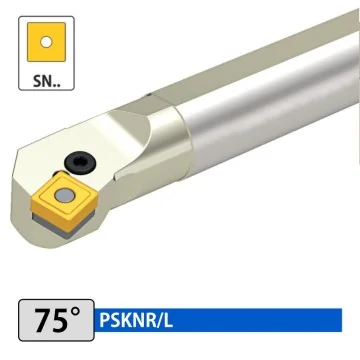
| Boring Bar | PSKNR/L |
| Cutting Angle | 75° |
| Insert | SN.. 1204 |
| Main application | Longitudinal turning |
| Clamping | Pin Lock |
| Cooling | Without Cooling Hole |
| Packaging unit | 1 Pc. |
| d | L | h | f | Dmin | |
| S25Q-PSKNR/L 12 | 25 | 180 | 23 | 17 | 32 |
| S25T-PSKNR/L 12 | 25 | 300 | 23 | 17 | 32 |
| S32R-PSKNR/L 12 | 32 | 200 | 30 | 22 | 44 |
| S32U-PSKNR/L 12 | 32 | 350 | 30 | 22 | 44 |
| S40S-PSKNR/L 12 | 40 | 250 | 37 | 27 | 54 |
| S40V-PSKNR/L 12 | 40 | 400 | 37 | 27 | 54 |
The PSKNR/L internal tool holder featuring a 75° cutting angle is designed for efficient longitudinal turning and internal operations. Compatible with SN.. 1204 inserts, this holder is an excellent choice for turning applications that operate without internal coolant supply.
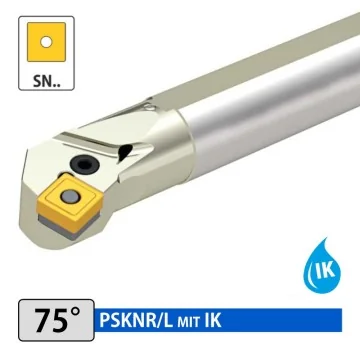
| Boring Bar | PSKNR/L |
| Cutting Angle | 75° |
| Insert | SN.. 1204 |
| Main application | Longitudinal turning |
| Clamping | Pin Lock |
| Cooling | With Cooling Hole |
| Packaging unit | 1 Pc. |
| d | L | h | f | Dmin | |
| A25R-PSKNR/L 12 | 25 | 200 | 24 | 17 | 32 |
| A32S-PSKNR/L 12 | 32 | 250 | 31 | 22 | 44 |
The PSKNR/L internal tool holder with integrated cooling holes and a 75° cutting angle is a professional solution for precise longitudinal turning. Thanks to the robust pin lock clamping system, the SN 1204 series insert is securely fixed at all times, providing excellent conditions for highly repeatable work processes. The targeted coolant supply supports chip control and optimizes the machining process in demanding metalworking applications.
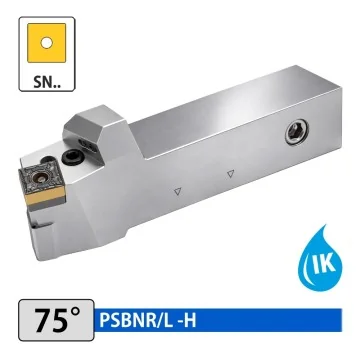
| External Tool Holder | PSBNR/L-H |
| Cutting Angle | 75° |
| Insert | SN.. |
| Main application | Longitudinal turning |
| Cooling | With coolant holes |
| Clamping | Pin Lock |
| Packaging unit | 1 Pc. |
| h=H | B | L | L1 | f | M | Insert | |
| PSBNR/L 2020 X12-H | 20 | 20 | 112 | 42 | 17 | G1/8" | SN. 1204.. |
| PSBNR/L 2525 X12-H | 25 | 25 | 127 | 42 | 22 | G1/8" | SN. 1204.. |
| PSBNR/L 3232 X19-H | 32 | 32 | 155 | 55 | 27 | G1/8" | SN. 1906.. |
The PSBNR/L-H external tool holder with a 75° cutting angle and reliable pin lock system is specifically designed for professional longitudinal turning. Equipped with internal coolant holes, this tool supports efficient chip evacuation and stable process conditions during demanding turning operations.
M= Coolant connection thread
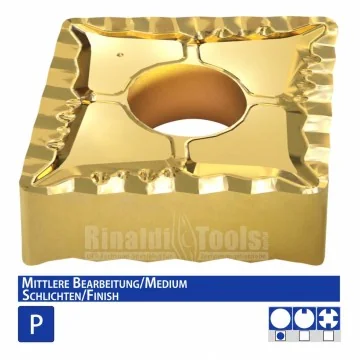
| Shape | CNMG |
| Processing | Medium and Finish |
| Cutting condition | Continuous |
| Workpiece Material | Steel |
| Grade | RT315G: Next-generation CVD-coated P15 carbide for continuous cutting. |
| Packaging unit | 10 Pc. |
| r | L | I.C. | S | |
| CNMG 120404-PF RT315G |
0,4 | 12,9 | 12,7 | 4,76 |
| CNMG 120408-PF RT315G |
0,8 | 12,9 | 12,7 | 4,76 |
| CNMG 120412-PF RT315G |
1,2 | 12,9 | 12,7 | 4,76 |
The CNMG-PF RT315G indexable insert is designed as a problem-solver for chip control in finishing and medium machining of steel. Thanks to the special PF geometry, it is ideal for use in soft and tough materials, delivering optimal results in chip formation and positively influencing surface qualities. Manufactured from next-generation CVD-coated P15 carbide, this tool demonstrates its strengths particularly in continuous cutting operations.
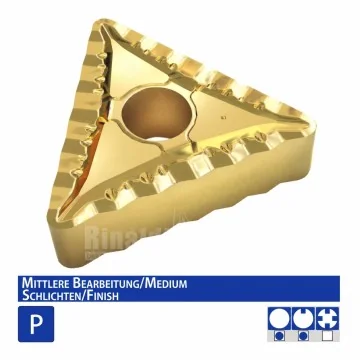
| Shape | TNMG |
| Processing | Medium and Finish |
| Cutting conditions | Continuous and light interrupted |
| Workpiece Material | Steel |
| Grade | RT325G: Next-generation CVD-coated P25-grade carbide for continuous and slightly interrupted cutting. |
| Packaging unit | 10 Pc. |
| r | L | I.C | S | d | |
| TNMG 160404-PF RT325G | 0,4 | 16,5 | 9,525 | 4,76 | 3,81 |
| TNMG 160408-PF RT325G | 0,8 | 16,5 | 9,525 | 4,76 | 3,81 |
| TNMG 160412-PF RT325G | 1,2 | 16,5 | 9,525 | 4,76 | 3,81 |
The TNMG-PF RT325G indexable insert is designed for efficient finishing and medium machining of steel materials. Thanks to the special PF geometry, it acts as an excellent problem-solver for soft and tough steel grades where clean chip formation is essential. The modern CVD-coated P25-grade carbide ensures stable operations during both continuous and slightly interrupted cutting. Its negative basic shape allows for the economical use of multiple cutting edges, which, combined with long tool life, significantly enhances the efficiency of your turning applications.

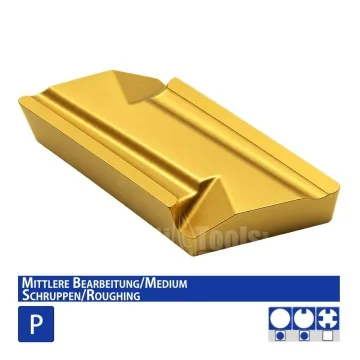
| Shape | KNUX |
| Processing | Medium and Roughing |
| Cutting condition | Continuous and light interrupted |
| Workpiece Material | Steel |
| Grade | RT250: CVD-coated P25-TIN hard metal for general steel processing |
| Packaging unit | 10 Pc. |
| r | La | brn | L | I.W | S | |
| KNUX 160405 L11 RT250 | 0,5 | 16 | 2,2 | 16,15 | 9,525 | 4,76 |
| KNUX 160405 R11 RT250 | 05 | 16 | 2,2 | 16,15 | 9,525 | 4,76 |
| KNUX 160410 L11 RT250 | 1 | 16 | 2,2 | 16,15 | 9,525 | 4,76 |
| KNUX 160410 R11 RT250 | 1 | 16 | 2,2 | 16,15 | 9,525 | 4,76 |
The KNUX R/L11 RT250 series indexable insert provides a professional solution for roughing and medium turning operations in steel. Featuring a proven CVD coating on a P25-TiN hard metal substrate, this tool is designed for reliable performance during continuous and light interrupted cuts. Available in right-hand and left-hand versions (R11/L11) with different corner radii, it offers flexible adaptation to diverse turning applications.
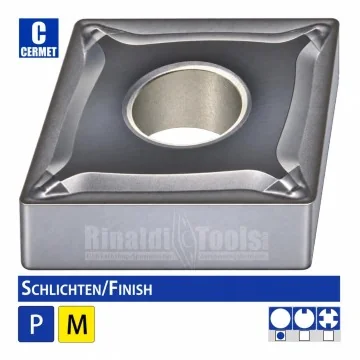
| Shape | CNMG |
| Processing | Finish |
| Cutting condition | Continuous |
| Workpiece Material | Steel and Stainless Steel |
| Grade | RTC+: PVD coated P05-P15 Cermet grade for finishing of steel and stainless steel |
| Packaging unit | 10 Pc. |
| r | L | I.C. | S | |
| CNMG 090304-SF RTC+ | 0,4 | 9,7 | 9,525 | 3,18 |
| CNMG 120404-SF RTC+ | 0,4 | 12,9 | 12,7 | 4,76 |
| CNMG 120408-SF RTC+ | 0,8 | 12,9 | 12,7 | 4,76 |
The indexable insert CNMG…-SF RTC+ is a tailored tooling solution for professional finishing operations on steel and stainless steel. Featuring the PVD-coated cermet grade RTC+, this insert supports consistently high surface qualities during continuous cutting processes. The proven negative CNMG geometry creates excellent conditions for low-vibration and dimensionally accurate turning results in CNC manufacturing.
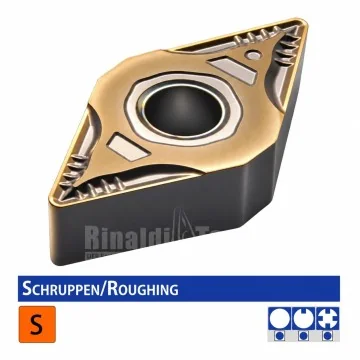
| Shape | DNMG |
| Processing | Roughing |
| Cutting condition | Continuous, light and heavy interrupted |
| Workpiece Material | Heat resistant super alloys |
| Grade | RT130S: PVD-coated special grade S05-S15 for heat resistant super alloys (turning) |
| Packaging unit | 10 Pc. |
| L | I.C | S | d | r | |
| DNMG 150608-SNR RT130S | 15,5 | 12,7 | 6,35 | 5,16 | 0,8 |
| DNMG 150612-SNR RT130S | 15,5 | 12,7 | 6,35 | 5,16 | 1,2 |
The DNMG turning insert with SNR geometry in the specialized RT130S grade is precisely designed for the roughing of difficult-to-machine heat-resistant super alloys. 
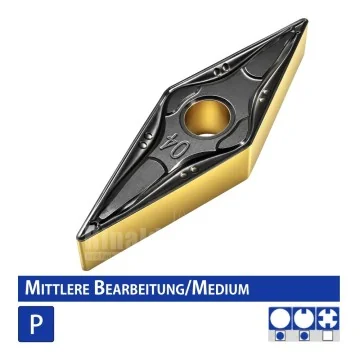
| Shape | VNMG |
| Processing | Medium |
| Cutting condition | Continuous and light interrupted |
| Workpiece Material | Steel |
| Grade | RT250+: CVD coated 2 color coated P20-P30 carbide for steel |
| Packaging unit | 10 Pc. |
| r | L | I.C | S | d | |
| VNMG 160404-PM RT250+ | 0,4 | 16,6 | 9,525 | 4,76 | 3,81 |
| VNMG 160408-PM RT250+ | 0,8 | 16,6 | 9,525 | 4,76 | 3,81 |
The indexable insert VNMG...-PM RT250+ provides a highly capable solution for professional steel turning. With its acute 35° rhombic shape, it ensures excellent workpiece accessibility, particularly during profile and contour turning operations. The PM geometry combined with a robust, two-color CVD coating makes this turning insert a reliable choice for medium machining under continuous or light interrupted cutting conditions.
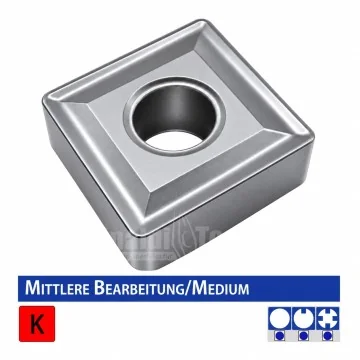
| Shape | SNMG |
| Processing | Medium |
| Cutting condition | Continuous, light and heavy interrupted |
| Workpiece Material | Cast Iron |
| Grade | RT150K: CVD-coated K10-K20 carbide for cast machining |
| Packaging unit | 10 Pc. |
| r | L | I.C | S | d | |
| SNMG 120408-KC RT150K | 0,8 | 12,7 | 12,7 | 4,76 | 5,16 |
| SNMG 120412-KC RT150K | 1,2 | 12,7 | 12,7 | 4,76 | 5,16 |
The SNMG...-KC RT150K is a professional solution for the turning of cast iron materials. Its stable SNMG geometry and specialized carbide grade provide excellent conditions for efficient industrial machining.
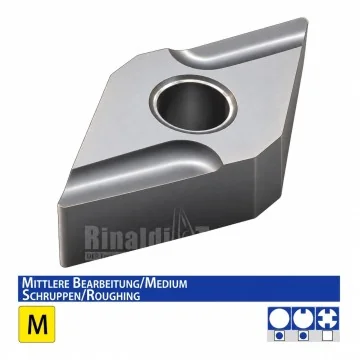
| Shape | DNMG |
| Processing | Roughing/Medium |
| Cutting condition | Continuous and light interrupted |
| Workpiece Material | Stainless Steel |
| Grade | RT305: PVD grade M20-M30 for stainless steel with the most modern coating |
| Packaging unit | 10 Pc. |
| r | L | I.C | S | d | |
| DNMG 150604-R RT305 | 0,4 | 15,5 | 12,7 | 6,35 | 5,16 |
| DNMG 150604-L RT305 | 0,4 | 15,5 | 12,7 | 6,35 | 5,16 |
| DNMG 150608-R RT305 | 0,8 | 15,5 | 12,7 | 6,35 | 5,16 |
| DNMG 150608-L RT305 | 0,8 | 15,5 | 12,7 | 6,35 | 5,16 |
The DNMG 1506...R/L RT305 indexable insert is a specialized solution for roughing and medium machining of stainless steels. Equipped with the modern PVD-coated RT305 grade, this 55° rhombic insert ensures a reliable performance in continuous and light interrupted cutting conditions.
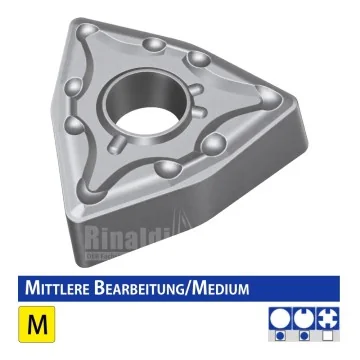
| Shape | WNMG |
| Processing | Medium |
| Cutting condition | Continuous and light interrupted |
| Workpiece Material | Stainless Steel |
| Grade | RT250M: PVD coated M20-M30 carbide. |
| Packaging unit | 10 Pc. |
| r | L | I.C | S | d | |
| WNMG 080404-MA RT250M | 0,4 | 8,7 | 12,7 | 4,76 | 5,16 |
| WNMG 080408-MA RT250M | 0,8 | 8,7 | 12,7 | 4,76 | 5,16 |
The WNMG ...-MA RT250M is an indexable turning insert specifically designed for machining stainless steel. Featuring a negative basic shape with an 80-degree angle, it provides six usable cutting edges, promoting excellent cost-efficiency in external and internal turning operations. The combination of PVD-coated M20-M30 carbide and the MA geometry, which is tailored for medium machining, supports a stable and reliable cutting process.
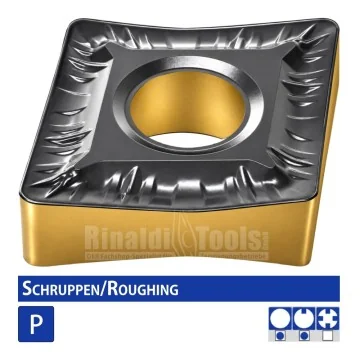
| Shape | CNMG |
| Processing | Roughing |
| Cutting condition RT215+ | Continuous |
| Cutting condition RT225+ | Continuous and light interrupted |
| Workpiece Material | Steel |
| Grade | RT225+: CVD coated 2-color P20 carbide the latest generation for general steel processing |
| Packaging unit | 10 Pc. |
| r | L | I.C. | S | |
| CNMG 120408-PR RT225+ | 0,8 | 12,9 | 12,7 | 4,76 |
| CNMG 120412-PR RT225+ | 1,2 | 12,9 | 12,7 | 4,76 |
| CNMG 120416-PR RT225+ |
1,6 | 12,9 | 12,7 | 4,76 |
| CNMG 160608-PR RT225+ |
0,8 | 16,1 | 15,875 | 6,35 |
| CNMG 160612-PR RT225+ |
1,2 | 16,1 | 15,875 | 6,35 |
| CNMG 160616-PR RT225+ |
1,6 | 16,1 | 15,875 | 6,35 |
| CNMG 190612-PR RT225+ |
1,2 | 19,3 | 19,05 | 6,35 |
| CNMG 190616-PR RT225+ |
1,6 | 19,3 | 19,05 | 6,35 |
| CNMG 190624-PR RT225+ |
2,4 | 19,3 | 19,05 | 6,35 |
The indexable insert CNMG...-PR RT225+ is a high-performance solution for heavy-duty turning in steel materials. Featuring a robust CVD-coated P20 carbide substrate, it performs consistently in continuous and light interrupted cutting conditions.
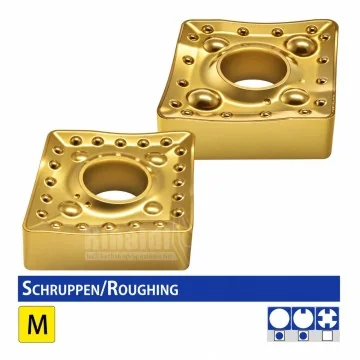
| Shape | CNMM |
| Processing | Roughing |
| Cutting condition | Continuous and light interrupted |
| Workpiece Material | Stainless Steel |
| Grade | RT255M: PVD coated M20-M30 carbide. First choice for stainless steel |
| Packaging unit | 10 Pc. |
| r | L | I.C. | S | |
| CNMM 120408-SXR RT255M | 0,8 | 12,9 | 12,7 | 4,76 |
| CNMM 120412-SXR RT255M | 1,2 | 12,9 | 12,7 | 4,76 |
| CNMM 160612-SXR RT255M | 1,2 | 16,1 | 15,875 | 6,35 |
| CNMM 160616-SXR RT255M | 1,6 | 16,1 | 15,875 | 6,35 |
| CNMM 190612-SXR RT255M | 1,2 | 19,3 | 19,05 | 6,35 |
| CNMM 190616-SXR RT255M | 1,6 | 19,3 | 19,05 | 6,35 |
| CNMM 190624-SXR RT255M | 2,4 | 19,3 | 19,05 | 6,35 |
The CNMM indexable insert featuring the SXR geometry and RT255M grade is engineered for demanding roughing operations in stainless steel. The PVD-coated M20-M30 carbide makes this insert an excellent choice for continuous and light interrupted cuts, ensuring stable and reliable machining processes.
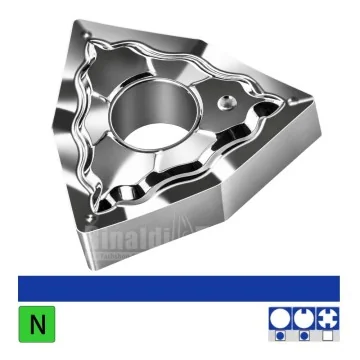
| Shape | WNMG |
| Workpiece Material | Aluminum, Plastics & NF-Metals |
| Cutting condition | Continuous and light interrupted |
| Grade | RT100: Uncoated K10-K15 carbide for Aluminum and plastics |
| Packaging unit | 10 Pc. |
| r | L | I.C | S | d | |
| WNMG 080404-ALZ RT100 | 0,4 | 8,7 | 12,7 | 4,76 | 5,16 |
| WNMG 080408-ALZ RT100 | 0,8 | 8,7 | 12,7 | 4,76 | 5,16 |
The uncoated WNMG ... -ALZ RT100 indexable insert is specially designed for the efficient turning of aluminum, plastics, and other non-ferrous metals. Featuring the ultra-sharp ALZ geometry combined with the tough K10-K15 carbide grade RT100, this tool provides excellent conditions for clean chip evacuation and smooth surface finishes in continuous to light interrupted cuts.
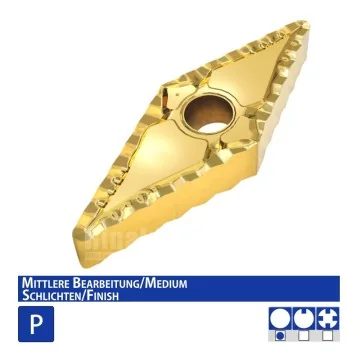
| Shape | VNMG |
| Processing | Medium and Finish |
| Cutting condition | Continuous |
| Workpiece Material | Steel |
| Grade | RT315G: Next-generation CVD-coated P15 carbide for continuous cutting. |
| Packaging unit | 10 Pc. |
| r | L | I.C | S | d | |
| VNMG 160404-PF RT315G | 0,4 | 16,6 | 9,525 | 4,76 | 3,81 |
| VNMG 160408-PF RT315G | 0,8 | 16,6 | 9,525 | 4,76 | 3,81 |
| VNMG 160412-PF RT315G | 0,8 | 16,6 | 9,525 | 4,76 | 3,81 |
The VNMG-PF indexable insert in grade RT315G is designed as a highly effective chip problem-solver for the steel sector. Its 35-degree rhombic geometry makes it exceptionally suitable for profiling and contouring tasks. When machining soft and tough materials, this specific geometry delivers optimal results in chip formation during continuous cuts. The outcome is enhanced surface qualities and an efficient workflow from finishing to medium machining.
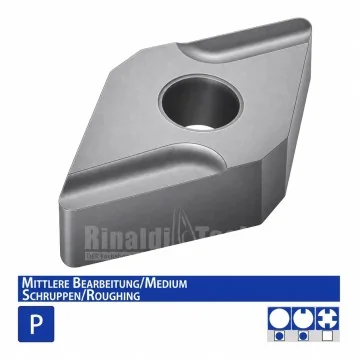
| Shape | DNMG |
| Processing | Roughing/Medium |
| Cutting condition | Continuous and light interrupted |
| Workpiece Material | Steel |
| Grade | RT250: CVD-coated P25-TIN hard metal for general steel processing |
| Packaging unit | 10 Pc. |
| r | L | I.C | S | d | |
| DNMG 150604-R/L RT250 | 0,4 | 15,5 | 12,7 | 6,35 | 5,16 |
| DNMG 150608-R/L RT250 | 0,8 | 15,5 | 12,7 | 6,35 | 5,16 |
The DNMG 1506...R/L indexable insert in grade RT250 is a specialized solution for roughing and medium machining of steel materials. The P25-TiN hard metal is provided with a robust CVD coating, making the insert a practical choice for professional use in continuous to light interrupted cutting conditions. This version creates a solid foundation for economical and reliable turning operations.
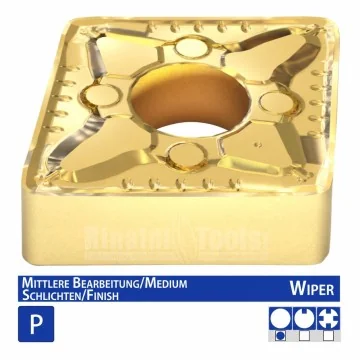
| Shape | CNMG |
| Processing | Finish/Medium |
| Cutting condition | Continuous |
| Workpiece Material | Steel |
| Grade | RT315G: Next-generation CVD-coated P15 carbide for continuous cutting. |
| Packaging unit | 10 Pc. |
| r | L | I.C. | S | |
| CNMG 120404-W RT315G | 0,4 | 12,9 | 12,7 | 4,76 |
| CNMG 120408-W RT315G | 0,8 | 12,9 | 12,7 | 4,76 |
| CNMG 120412-W RT315G | 1,2 | 12,9 | 12,7 | 4,76 |
The indexable insert of the CNMG...-W series featuring the RT315G grade is a high-performance solution for finishing and medium machining of steel. Equipped with a special wiper geometry, this version extends the contact area with the workpiece surface. This allows operators to achieve very good surface finishes at consistently high feed rates or to reduce machining times while maintaining finish quality. Consequently, subsequent operations are often rendered unnecessary. The CVD-coated P15 carbide ensures thermal stability in continuous cutting.
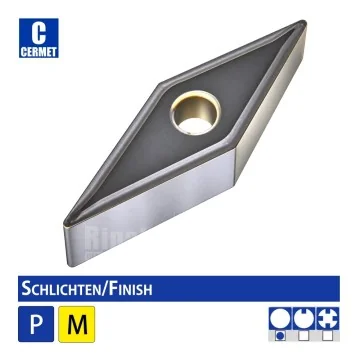
| Shape | VNMG |
| Processing | Finish |
| Cutting condition | Continuous |
| Workpiece Material | Steel and Stainless Steel |
| Grade | RTC+: PVD coated P05-P15 Cermet grade for finishing of steel and stainless steel |
| Packaging unit | 10 Pc. |
| r | L | I.C | S | d | |
| VNMG 160404-SF RTC+ | 0,4 | 16,6 | 9,525 | 4,76 | 3,81 |
| VNMG 160408-SF RTC+ | 0,8 | 16,6 | 9,525 | 4,76 | 3,81 |
The indexable insert VNMG...-SF RTC+ is designed for professional finishing of steel and stainless steel. Featuring a PVD-coated Cermet grade and an advanced SF geometry, it supports excellent surface qualities and accurate contours under continuous cutting conditions.