


 Deutsch
 English
CBN Indexable Inserts: The Powerhouses in Turning Operations
Related Products

Indexable CBN-Insert - CNGA 1204..-2N RTC20T
Technical data
| Shape | CNGA |
| Scope of application | Hard turning |
| Cutting edges | 2 |
| Grade | RTC20T : TIN-coated CBN for full to slightly interrupted cuts in hardened steels |
| Packaging unit | 2 Pc |
Dimensions
| I.C. | S | r | d | L | |
| CNGA 120404-2N RTC20T | 12,7 | 4,76 | 0,4 | 5,16 | 2,2 |
| CNGA 120408-2N RTC20T | 12,7 | 4,76 | 0,8 | 5,16 | 2,2 |
| CNGA 120412-2N RTC20T | 12,7 | 4,76 | 1,2 | 5,16 | 2,2 |
Hard turning with the CNGA 1204..-2N RTC20T
The indexable CBN-insert CNGA 1204..-2N RTC20T is designed for demanding hard turning operations. Featuring two cutting edges and the TiN-coated RTC20T CBN grade, this tool provides a reliable solution for full to slightly interrupted cuts in hardened steels.
Advantages of CNGA 1204..-2N RTC20T
- TiN-coated CBN ensures robust wear resistance when machining hardened steels
- Reliable performance in continuous to slightly interrupted cutting conditions
- Cost-effective operation due to the design with two usable cutting edges
- Three corner radii (0.4 mm, 0.8 mm, and 1.2 mm) support flexible application options

Indexable CBN-Insert - CCGW ...-2N RTC20T
Technical data
| Shape | CCGW |
| Scope of application | Hard turning |
| Cutting edges | 2 |
| Grade | RTC20T : TIN-coated CBN for full to slightly interrupted cuts in hardened steels |
| Packaging unit | 2 Pc |
Dimensions
| I.C. | S | r | L | |
| CCGW 060202-2N RTC20T | 6,35 | 2,38 | 0,2 | 2,2 |
| CCGW 060204-2N RTC20T | 6,35 | 2,38 | 0,4 | 2,2 |
| CCGW 060208-2N RTC20T | 6,35 | 2,38 | 0,8 | 2,2 |
| CCGW 09T302-2N RTC20T | 9,525 | 3,97 | 0,2 | 2,2 |
| CCGW 09T304-2N RTC20T | 9,525 | 3,97 | 0,4 | 2,2 |
| CCGW 09T308-2N RTC20T | 9,525 | 3,97 | 0,8 | 2,2 |
| CCGW 09T312-2N RTC20T | 9,525 | 3,97 | 1,2 | 2,2 |
| CCGW 120404-2N RTC20T | 12,7 | 4,76 | 0,4 | 2,2 |
High-precision hard turning with the CCGW geometry
The indexable CBN-insert CCGW ...-2N RTC20T is specifically designed for the professional machining of hardened steels. Thanks to the TiN coating on wear-resistant polycrystalline cubic boron nitride, this tool enables reliable performance in full to slightly interrupted cuts.
Advantages of Indexable CBN-Insert CCGW ...-2N RTC20T
- TiN-coated CBN for high wear resistance on hard materials
- Two usable cutting edges for economical operation
- Specialized for continuous to slightly interrupted machining applications
- Reliable hard turning as a stable alternative to grinding

Indexable CBN-Insert - DNGA 1506..-2N RTC20T
Technical data
| Shape | DNGA |
| Scope of application | Hard turning |
| Cutting edges | 2 |
| Grade | RTC20T : TIN-coated CBN for full to slightly interrupted cuts in hardened steels |
| Packaging unit | 2 Pc |
Dimensions
| I.C. | S | r | d | L | |
| DNGA 150604-2N RTC20T | 12,7 | 6,35 | 0,4 | 5,16 | 2,2 |
| DNGA 150608-2N RTC20T | 12,7 | 6,35 | 0,8 | 5,16 | 2,2 |
Precise Hard Turning with DNGA 1506..-2N RTC20T
The indexable CBN-insert DNGA 1506..-2N RTC20T from Rinaldi-Tools is expertly designed for the demanding hard turning of hardened steels. Featuring a wear-resistant TiN coating and two robust cutting edges, this tool supports efficient and precise machining operations, even during slightly interrupted cuts.
Advantages of the Indexable CBN-Insert DNGA 1506..-2N RTC20T
- Designed for full to slightly interrupted cuts
- Two usable cutting edges for excellent cost-effectiveness
- Durable TiN coating provides enhanced wear resistance
- Optimized for reliable performance on hardened steels

Indexable CBN-Insert - DCGW ...-2N RTC20T
Technical data
| Shape | DCGW |
| Scope of application | Hard turning |
| Cutting edges | 2 |
| Grade | RTC20T : TIN-coated CBN for full to slightly interrupted cuts in hardened steels |
| Packaging unit | 2 Pc |
Dimensions
| I.C. | S | r | d | L | |
| DCGW 070204-2N RTC20T | 6,35 | 2,38 | 0,4 | 2,8 | 2,2 |
| DCGW 070208-2N RTC20T | 6,35 | 2,38 | 0,8 | 2,8 | 2,2 |
| DCGW 11T302-2N RTC20T | 9,525 | 3,97 | 0,2 | 4,4 | 2,2 |
| DCGW 11T304-2N RTC20T | 9,525 | 3,97 | 0,4 | 4,4 | 2,2 |
| DCGW 11T308-2N RTC20T | 9,525 | 3,97 | 0,8 | 4,4 | 2,2 |
Professional Machining with DCGW ...-2N RTC20T
The indexable CBN-insert DCGW ...-2N RTC20T is specifically designed for the demanding hard turning of hardened steels. Equipped with two cutting edges and a robust TiN coating, this insert supports efficient machining processes in continuous to slightly interrupted cuts.
Advantages of the Indexable CBN-Insert DCGW ...-2N RTC20T
- Design with two usable cutting edges for efficient operations
- Wear-resistant TiN coating optimized for hardened steel
- Practical concept for full to slightly interrupted cuts
- High thermal stability provided by the CBN cutting material
- Reliable delivery in a packaging unit of 2 pieces

Indexable CBN-Insert - WNGA 0804..-3N RTC20T
Technical data
| Shape | WNGA |
| Scope of application | Hard turning |
| Cutting edges | 3 |
| Grade | RTC20T : TIN-coated CBN for full to slightly interrupted cuts in hardened steels |
| Packaging unit | 2 Pc |
Dimensions
| I.C. | S | r | d | L | |
| WNGA 080404-3N RTC20T | 12,7 | 4,76 | 0,4 | 5,16 | 2,2 |
| WNGA 080408-3N RTC20T | 12,7 | 4,76 | 0,8 | 5,16 | 2,2 |
High-Precision CBN Insert for Hardened Steels
The WNGA 0804..-3N RTC20T indexable insert is explicitly engineered for professional hard turning operations. Featuring three resilient cutting edges and a heat-resistant TiN coating on the CBN substrate, this turning tool excels in continuous to slightly interrupted cuts. It supports efficient workflows by providing consistent dimensional accuracy and dependable machining performance.
Advantages of WNGA 0804..-3N RTC20T
- Designed for reliable hard turning in continuous and slightly interrupted applications
- Economic usage through three fully functional cutting edges per insert
- Enhanced thermal stability provided by the TiN-coated CBN material
- Supplied in a practical packaging unit (2 pieces) for immediate availability
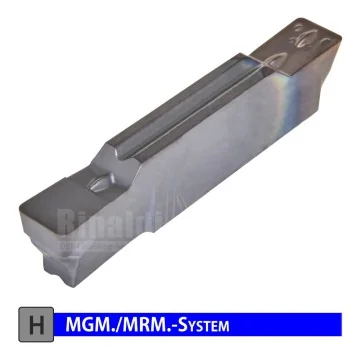
Grooving insert - MGGN ...-CBN RTC20
Technical data
| Grooving Insert | MGGN |
| Workpiece Materials | Hard Materials |
| Grade | RTC20=CBN fine grain grade for grooving in hardened steel, also in interrupted cut |
| Grooving system | MGM./MRM.-System |
| Packaging unit | 1 Pc. |
Dimensions
| B | R | L | S | |
| MGGN 200-CBN RTC20 | 2 | 0,2 | 16 | 4,8 |
| MGGN 300-CBN RTC20 | 3 | 0,4 | 21 | 4,8 |
Precise grooving in hard materials
The grooving insert MGGN ...-CBN RTC20 is a high-performance solution for demanding grooving operations in hardened steels. Thanks to the special RTC20 fine-grain CBN grade, this tool reliably masters both continuous and interrupted cuts and is optimally tailored for professional turning applications within the MGM./MRM. system.
Advantages of MGGN ...-CBN RTC20
- Suitable for hard materials and hardened steel
- Stable RTC20 fine-grain CBN grade for interrupted cuts
- Perfectly matched to the established MGM./MRM. grooving system
- Creates excellent conditions for reliable hard turning
- Available in practical grooving widths of 2 mm and 3 mm