

 Deutsch
 English
High-Feed Milling - Efficient Machining
Related Products
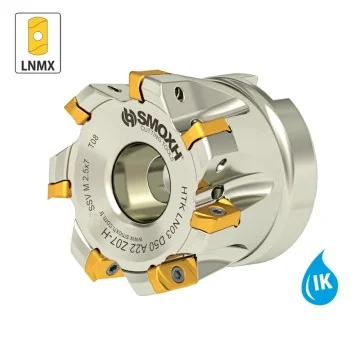
High Feed Mill - HTK LNMX 0303
Technical data
| Mill typ | High Feed Mill |
| Insert | LNMX 0303 |
| Packaging unit | 1 Pc. |
Dimensions
| D | d | L | ap max | Z | Insert | |
| HTK LN03 D40 A16 Z05-H | 40 | 16 | 40 | 1 | 5 | LNMX 0303 |
| HTK LN03 D42 A16 Z05-H | 42 | 16 | 40 | 1 | 5 | LNMX 0303 |
| HTK LN03 D50 A22 Z07-H | 50 | 22 | 40 | 1 | 7 | LNMX 0303 |
| HTK LN03 D52 A22 Z07-H | 52 | 22 | 40 | 1 | 7 | LNMX 0303 |
High-performance milling for modern machining centers
The SMOXH High Feed Mill HTK LNMX 0303 is designed for high-performance machining with low depths of cut and exceptionally high feed rates. Utilizing reliable LNMX 0303 indexable inserts combined with integrated internal cooling, this milling tool supports excellent chip evacuation and promotes consistently high material removal rates.
Advantages of High Feed Mill - HTK LNMX 0303
- Targeted internal coolant supply (-H) ensures safe process control and optimized chip breaking
- Stable clamping for LNMX 0303 indexable inserts provides outstanding machining performance
- High material removal rates at a maximum depth of cut (ap) of 1 mm
- Various diameters and flute counts offer versatile application possibilities
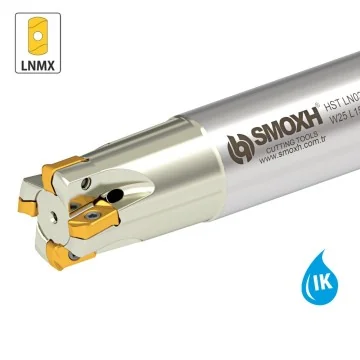
High Feed Mill - HST LNMX 0303
Dimensions
| D | d | L | L1 | ap max | Z | |
| HST LN03 D16 W16 L150 Z02-H | 16 | 16 | 150 | 40 | 1 | 2 |
| HST LN03 D20 W20 L150 Z03-H | 20 | 20 | 150 | 40 | 1 | 3 |
| HST LN03 D25 W25 L150 Z04-H | 25 | 25 | 150 | 40 | 1 | 4 |
| HST LN03 D32 W32 L150 Z05-H | 32 | 32 | 150 | 40 | 1 | 5 |
High Feed Mill HST LNMX 0303 by SMOXH
The SMOXH HST LNMX 0303 high feed mill is designed for professional machining operations with elevated feed rates. Utilizing a long tool body and economical LNMX 0303 indexable inserts, this tool supports efficient roughing and achieves a high material removal rate at a maximum depth of cut of 1 mm.
Advantages of the HST LNMX 0303
- Supports efficient machining processes with high feed rates
- Versatile options available with 2 to 5 teeth for various setups
- Designed for the use of highly economical LNMX 0303 inserts
- Extended reach thanks to a practical overall length of 150 mm
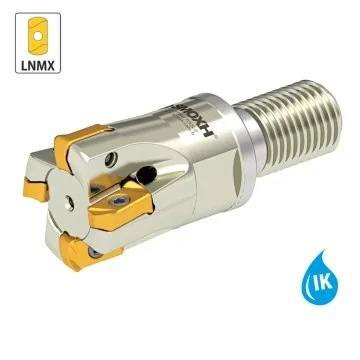
High Feed Modular Mill - MHT LNMX 0303
Technical data
| Mill type | High Feed Mill |
| Insert | LNMX 0303 |
| Packaging unit | 1 Pc. |
Dimensions
| D | Z | d1 | d2 | L | L1 | M | ap max | |
| MHT LN03 D16 M08 L25 Z02-H | 16 | 2 | 15 | 8,5 | 25 | 17 | 8 | 1 |
| MHT LN03 D20 M10 L30 Z03-H | 20 | 3 | 18 | 10,5 | 30 | 19 | 10 | 1 |
| MHT LN03 D25 M12 L35 Z04-H | 25 | 4 | 21 | 12,5 | 35 | 23 | 12 | 1 |
| MHT LN03 D32 M16 L43 Z05-H | 32 | 5 | 29 | 17 | 43 | 23 | 16 | 1 |
| MHT LN03 D35 M16 L43 Z05-H | 35 | 5 | 29 | 17 | 43 | 23 | 16 | 1 |
| MHT LN03 D40 M16 L43 Z06-H | 40 | 6 | 29 | 17 | 43 | 23 | 16 | 1 |
| MHT LN03 D42 M16 L43 Z06-H | 42 | 6 | 29 | 17 | 43 | 23 | 16 | 1 |
Compact High Feed Modular Mill for Maximum Productivity
The SMOXH High Feed Modular Mill MHT LNMX 0303 is designed for reliable high feed milling operations. Thanks to its robust modular screw-in connection and compatibility with LNMX 0303 inserts, it delivers high metal removal rates while maintaining excellent stability.
Advantages of MHT LNMX 0303
- Rigid screw-in connection for vibration-reduced milling
- Optimized for high feed rates and shorter machining times
- Compact design allows excellent accessibility in deep cavities
- Flexible modular setup with standard M8 to M16 threads
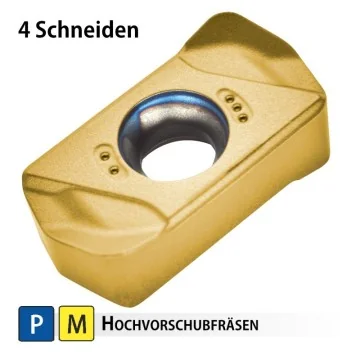
High Feed Milling Insert - LNMX 0303-MU RT300/RT330
Technical data
| Shape | LNMX |
| Processing | High Feed |
| Workpiece Material | Steel and Stainless Steel |
| Grade |
RT300: PVD-coated P15-P25 and M10-M25 for universal use in steel and stainless steel |
|
RT330: PVD-coated P15-P25 and M10-M25 with additional TiN-coating for improved wear-detection |
|
| Packaging unit | 10 Pc. |
Dimensions
| L | apmax | W | S | r | |
| LNMX 0303-MU RT300 | 11,86 | 1,00 | 6 | 4,29 | 1,20 |
| LNMX 0303-MU RT330 New! | 11,86 | 1,00 | 6 | 4,29 | 1,20 |
High Feed Milling Insert LNMX 0303-MU
The compact high feed milling insert LNMX 0303-MU in grades RT300 and RT330 is a professional solution for machining steel and stainless steel. Its well-thought-out design supports efficient material removal at high feed rates.
Advantages of High Feed Milling Insert - LNMX 0303-MU RT300/RT330
- Applicable from Ø 16 mm thanks to a compact insert design
- Soft-cutting geometry ensures low cutting forces
- Increased material removal rate, even on low-power machines
- Double-sided insert with 4 cutting edges for excellent cost-effectiveness
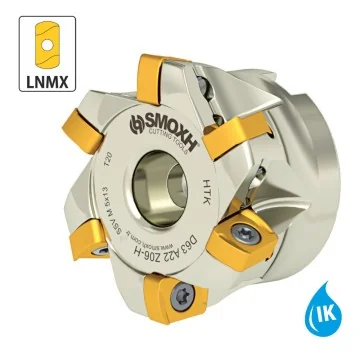
High Feed Mill - HTK LNMX 0904
Technical data
| Mill type | High Feed Mill |
| Insert | LNMX 0904 |
| Packaging unit | 1 Pc. |
Dimensions
| D | d | L | ap max | Z | Insert | |
| HTK BL09 D40 A16 Z05-H | 40 | 16 | 40 | 1,5 | 5 | LNMX 0904 |
| HTK BL09 D42 A16 Z05-H | 42 | 16 | 40 | 1,5 | 5 | LNMX 0904 |
| HTK BL09 D50 A22 Z06-H | 50 | 22 | 40 | 1,5 | 6 | LNMX 0904 |
| HTK BL09 D52 A22 Z06-H | 52 | 22 | 40 | 1,5 | 6 | LNMX 0904 |
| HTK BL09 D63 A22 Z07-H | 63 | 22 | 40 | 1,5 | 7 | LNMX 0904 |
| HTK BL09 D66 A27 Z08-H | 66 | 27 | 50 | 1,5 | 8 | LNMX 0904 |
| HTK BL09 D80 A27 Z10-H | 80 | 27 | 50 | 1,5 | 10 | LNMX 0904 |
| HTK BL09 D100 A32 Z12-H | 100 | 32 | 50 | 1,5 | 12 | LNMX 0904 |
Precise high feed mill for efficient machining
The high feed mill HTK LNMX 0904 by SMOXH is designed for productivity and high metal removal rates. Combined with matching LNMX 0904 inserts, it reliably supports professional users in demanding milling applications.
Advantages of High Feed Mill HTK LNMX 0904
- Supports high metal removal rates during machining
- Versatile sizes from 40 mm up to 100 mm in diameter available
- Designed with a high number of flutes featuring up to twelve teeth
- Practical arbor mounting for stable milling processes
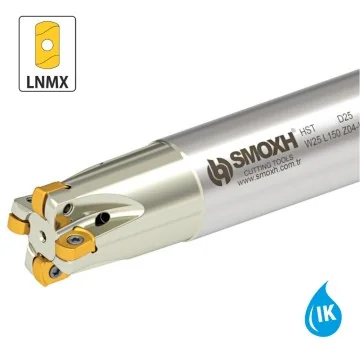
High Feed Mill - HST LNMX 0904
Technical data
| Mill typ | High Feed Mill |
| Insert | LNMX 0904 |
| Packaging unit | 1 Pc. |
Dimensions
| D | d | L | L1 | Z | ap max | Insert | |
| HST BL09 D25 W25 L150 Z03-H | 25 | 25 | 150 | 40 | 3 | 1,5 | LNMX 0904 |
| HST BL09 D32 W32 L150 Z04-H | 32 | 32 | 150 | 40 | 4 | 1,5 | LNMX 0904 |
High-performance High Feed Mill for maximum productivity
The SMOXH high feed mill HST LNMX 0904 is engineered as a robust tool holder designed for demanding machining tasks at extremely high feed rates. With its well-thought-out design, this shank milling cutter is ideal for highly efficient roughing and face milling where a large material removal rate is required.
Advantages of HST LNMX 0904
- Designed for high feed speeds with reduced cutting forces
- Compatible with high-performance LNMX 0904 indexable inserts
- Sturdy straight shank ensures low-vibration and stable operation
- Perfect for economical batch production and heavy-duty cutting operations
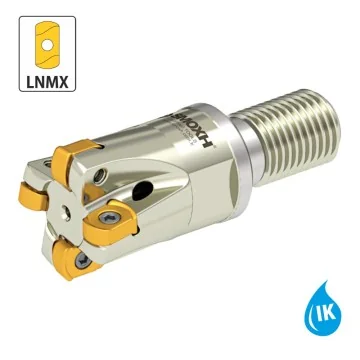
High Feed Modular Mill - MHT LNMX 0904
Technical data
| Mill typ | High Feed Mill |
| Insert | LNMX 0904 |
| Packaging unit | 1 Pc. |
Dimensions
| D | Z | d1 | d2 | L | L1 | M | ap max | |
| MHT BL09 D25 M12 L35 Z03-H | 25 | 3 | 21 | 12,5 | 35 | 23 | 12 | 1,5 |
| MHT BL09 D32 M16 L43 Z04-H | 32 | 4 | 29 | 17 | 43 | 23 | 16 | 1,5 |
| MHT BL09 D35 M16 L43 Z04-H | 35 | 4 | 29 | 17 | 43 | 23 | 16 | 1,5 |
| MHT BL09 D40 M16 L43 Z05-H | 40 | 5 | 29 | 17 | 43 | 23 | 16 | 1,5 |
High-performance modular mill for high feed milling
The SMOXH high feed modular mill MHT LNMX 0904 is designed for efficient machining with extremely high feed rates. Its compact screw-in design allows for flexible adaptation to different machining depths while providing excellent process stability.
Advantages of MHT LNMX 0904
- Compact screw-in design (M12/M16) for versatile, modular applications
- High metal removal rates due to high feed technology with up to 1.5 mm depth of cut
- Designed for LNMX 0904 indexable inserts
- Available with 3 to 5 cutting edges (Z) for optimal productivity
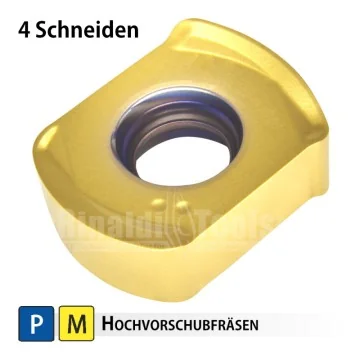
High Feed Milling Insert - LNMX 0603/0904-MU RT330
Technical data
| Shape | LNMX |
| Processing | High Feed |
| Workpiece Material | Steel and Stainless Steel |
| Grade | RT330: PVD-coated P15-P25 and M10-M25 for universal use in steel and stainless steel |
| Cutting edges | 4 |
| Packaging unit | 10 Pc. |
Dimensions
| L | APmax | W | S | r | |
| LNMX 0603-MU RT330 | 9 | 1 | 6,39 | 3,73 | 1,20 |
| LNMX 0904-MU RT330 | 11,94 | 1,50 | 9,20 | 4,79 | 1,20 |
High-performance milling insert for high feed rates
The high feed milling insert LNMX-MU in the RT330 grade is a professional solution for the efficient machining of steel and stainless steel. Thanks to its soft-cutting geometry, it reduces cutting forces and creates excellent conditions for high metal removal rates, making it highly suitable even for use on low-power machines.
Advantages of LNMX 0603/0904-MU RT330
- Soft-cutting geometry ensures low cutting forces and smooth operation
- Double-sided design with four usable cutting edges for excellent cost-effectiveness
- Generously sized insert enables higher feed rates and depths of cut
- PVD-coated RT330 grade (P15-P25 / M10-M25) for versatile applications
- Practical packaging unit of 10 pieces for reliable inventory management